
THE
DIGITAL
EMBELLISHMENT
MANIFESTO
The End of Commodity Print
For half a century, the printing industry chased the wrong metric. It optimized for speed. It competed on price. It turned a tactile, sensory medium into a commodity - and then wondered why the world stopped noticing.
The Digital Embellishment Manifesto is a line in the sand. A declaration that print was never meant to compete on efficiency, but on experience. Grounded in neuroscience, proven in the market, and driven by those who have spent their careers showing that what your fingers feel changes what your brain believes, it reframes the entire industry: print is not visual first - it is tactile.
Ninety-five theses. Seven principles. One movement to end commodity print - and remind the world what this medium is actually capable of.
By signing, you're joining the early voices shaping what comes next. As one of the first to stand behind this movement, you'll receive the 95 Theses - a foundational articulation of what print must become - as a gift for leading, not following.
147
Signers so far
Milestone Goal
150
3
To go
From the Manifesto
Selected Theses
Print stopped being special.
Thesis 4
But the internet did not kill print. We devalued it ourselves.
Thesis 10
Print does not win by being digital. Print wins by being physical.
Thesis 17
This is not sentiment. This is biology.
Thesis 27
Flat print competes with screens. Dimensional print competes with nothing.
Thesis 37
Print is inherently tactile.
Thesis 39
Embellishment is not decoration. It is differentiation.
Thesis 51
The market does not need more print. It needs more memorable print.
Thesis 55
The only thing missing is the will to use it.
Thesis 75
The future of print is tactile. And it starts now.
Thesis 95
Swipe or navigate
"Print is not dying. It is becoming something far more powerful. Something physical. Something dimensional. Something you can feel."
— Thesis 94
Join the Waitlist
get the book
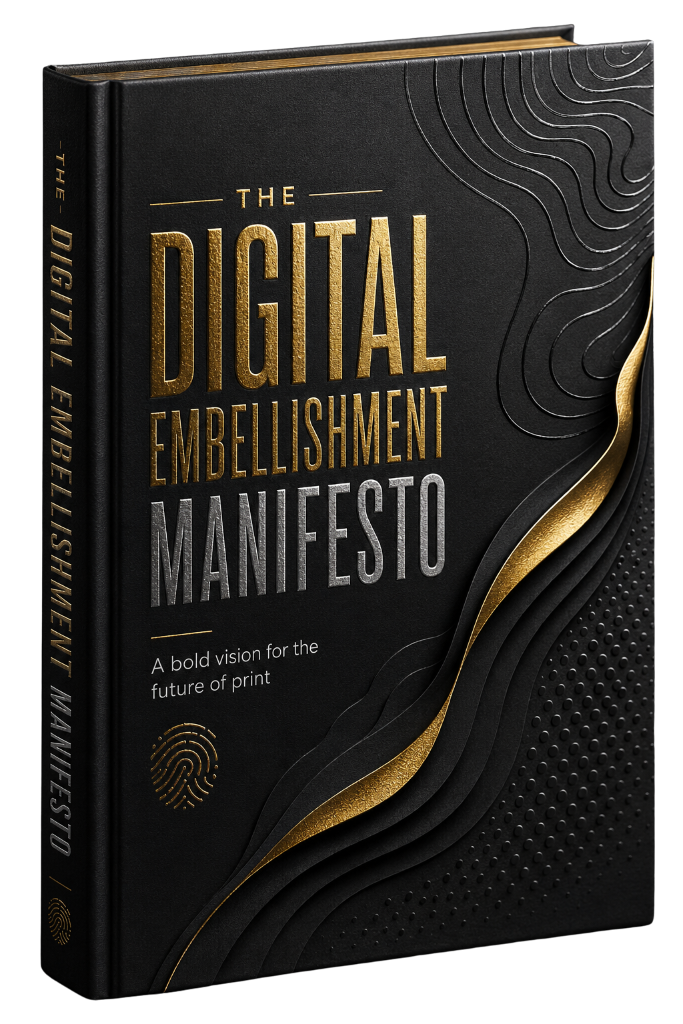
We believe in this movement so deeply that we didn't just talk about it - we wrote a book about it. We turned years of real-world results, market data, and hands-on experience into a definitive point of view on where print is going and why it matters. This isn't theory. It's what we've seen work, again and again, for brands and print providers who chose to move beyond commodity.
Written by Taktiful CEO Kevin Abergel and CXO Eric Vessels, this book captures the thinking behind the Digital Embellishment Manifesto and the shift already underway across the industry. If you're ready to see where print is headed next, get on the waitlist and be the first to access it when it launches this fall.
147
Signers so far
Milestone Goal
150
3
To go
Inside the Book
Seven Chapters. One Mission.
A journey from the commoditization of print to the tactile revolution that's already underway.
The Commodity Trap
How the printing industry lost sight of what made print powerful.
The Forgotten Sense
The neuroscience of touch and why we trust what we can feel.
What the Shelf Knows
Print's tactile power in a world dominated by screens.
Print Is Inherently Tactile
The thesis that changes everything about how we think about print.
The New Workflow
How embellishment technology is reshaping modern production.
The Objections
Addressing resistance and building the case for tactile print.
The Age of Tactile Print
A vision for the future and the movement that will get us there.
The Tactile Toolkit
Tools, templates, and case studies to turn the argument into action in your own shop.
Featured Voice
“I’m excited about the opportunity to promote the value and benefits of print embellishments.”
Blitzprint
Calgary, Canada
Signers of the Manifesto
Join the Movement
147 signers from 17 countries
View the mapCompanies of the Manifesto
Industry Leaders
32 companies from 10 countries
Voices of the Movement
Why They Signed
The Foundation
The 95 Theses
For twenty years, the printing industry has been chasing efficiency.
Faster presses. Shorter runs. Lower prices.
In that race, something was lost.
Print stopped being special.
We optimized print until it became invisible.
Commodity print is everywhere — which means it is noticed nowhere.
Every printer can match your price. Every press can match your speed. And the market learned to care about neither.
We taught our customers that print is cheap. They believed us.
Then we blamed the internet for our shrinking margins.
But the internet did not kill print. We devalued it ourselves.
For a generation, printers have asked the wrong question.
They asked: how do we compete with digital media?
That was never the right fight.
Digital media is information at the speed of light. Print cannot outrun it.
Screens are instant, infinite, and illuminated. Print will never be faster, cheaper, or more connected.
Every dollar spent making print act more like a screen is a dollar wasted.
Print does not win by being digital. Print wins by being physical.
And yet the industry spent two decades trying to digitize its way to relevance.
The result is a market that sees print as a cost, not a value.
That ends now.
The human brain processes touch before it processes language.
An infant reaches before it reads. Texture is our first vocabulary.
Neuroscience confirms what artisans have known for centuries: we trust what we can feel.
We remember what engages multiple senses.
A screen can show you a product. Only a physical object can make you want to hold it.
Touch creates emotional memory. Sight alone does not.
This is not sentiment. This is biology.
And it is the single greatest competitive advantage print has ever had.
Something is happening in the marketplace that most printers have not yet noticed.
Consumers are overwhelmed by screens.
The average person encounters thousands of digital impressions every day. They remember almost none.
But hand someone a piece of print that feels different — raised, textured, metallic, dimensional — and they stop.
They touch it. They turn it over. They remember it.
The brands that understand this are already changing their packaging, their marketing, their direct mail.
The shelf is no longer a display. It is a battlefield.
And the weapon is sensory experience.
Flat print competes with screens. Dimensional print competes with nothing.
Here is the thesis that changes everything:
Print is inherently tactile.
Not optionally. Not as a luxury upgrade. Inherently.
Every printed piece has texture. Every surface has weight, tooth, finish. Every substrate has a story the fingers can read.
The industry just forgot to tell that story.
We stripped print of its physicality in the name of efficiency, and then wondered why no one valued it.
Restoring tactile intention to print is not adding a feature. It is returning to purpose.
Print that ignores touch is print that ignores its own superpower.
The old thinking says finishing is optional.
The old thinking says customers won't pay for embellishment.
The old thinking says embellishment is a niche market for luxury brands.
The old thinking is wrong.
Finishing is not optional. It is the value.
Embellishment is not decoration. It is differentiation.
And differentiation is the only thing that separates a $0.08 postcard from a $0.80 experience.
Printers who treat embellishment as an add-on will spend the rest of their careers competing on price.
Printers who treat embellishment as the product will set the price.
The market does not need more print. It needs more memorable print.
Ink communicates.
Texture persuades.
Reflection attracts.
Dimension commands attention.
Soft-touch says premium. Raised varnish says crafted. Foil says unmistakable.
These are not finishing effects. They are a language.
Designers who speak this language create work people keep.
Designers who ignore it create work people discard.
Every printed surface is a conversation between the eye and the hand.
The best print wins both.
For decades, tactile effects were analog. Expensive. Slow. Reserved for long runs and large budgets.
Digital embellishment changes the equation.
It brings dimension into the digital workflow.
It makes tactile print scalable.
It makes premium achievable — not just for luxury brands, but for every print buyer.
Digital embellishment is not a press. It is a paradigm.
Variable data meets variable texture. Personalization meets sensation.
Short runs become high-impact runs.
The technology exists today to make every printed piece an experience.
The only thing missing is the will to use it.
The printers who thrive in the next decade will not be the fastest.
They will be the ones who make people stop, touch, and remember.
They will not sell ink on paper. They will sell sensory experiences.
They will not ask "how many copies?" They will ask "how do you want it to feel?"
They will not compete on turnaround time. They will compete on emotional impact.
They will design workflows around dimension, not just around delivery.
They will educate their customers on what print can become.
Because customers do not yet know what to ask for. They are waiting to be shown.
Stop asking if customers want embellishment. Start showing them what is possible.
The market will follow the printers who lead.
This is not a technology trend. This is a philosophical shift.
The age of commodity print is ending. The age of tactile print is beginning.
Every printer, designer, brand owner, and marketer who touches a printed piece has a choice.
Keep competing on price, speed, and sameness.
Or start creating print that people want to hold.
There is no middle ground.
The question is no longer whether embellishment matters.
The question is who will embrace it first.
Print is not dying. It is becoming something far more powerful. Something physical. Something dimensional. Something you can feel.
The future of print is tactile. And it starts now.
Riff the Manifesto
Your Thesis
What's the thesis you'd nail to the door? Share yours below. Theses from signers who chose to display their name publicly will appear in the carousel.
Theses from Signers
"Take the time to understand a client’s true needs and objectives before ever responding to a request a for proposal."
Questions